Warm Minimal Interior in a Tampines HDB: How to Match Bedside Tables, Beds and Dining Pieces Without Losing the Cosy
Last month I visited a 92 sqm HDB flat in Tampines North with a young couple who had spent S$48,000 on a renovation but felt the rooms still looked "a bit cold." The flooring was pale vinyl, the walls were a clean off-white (Nippon Snow Easy Mate White 9P2 at a ratio of about 1 litre to 10 sqm), and the lighting was the standard 4000K downlights every contractor installs by default. They owned a pale grey fabric sofa, a 1.6 m dining table in white laminate, and two identical white bedside tables from a big-box store. Nothing was wrong, and yet nothing felt like theirs.
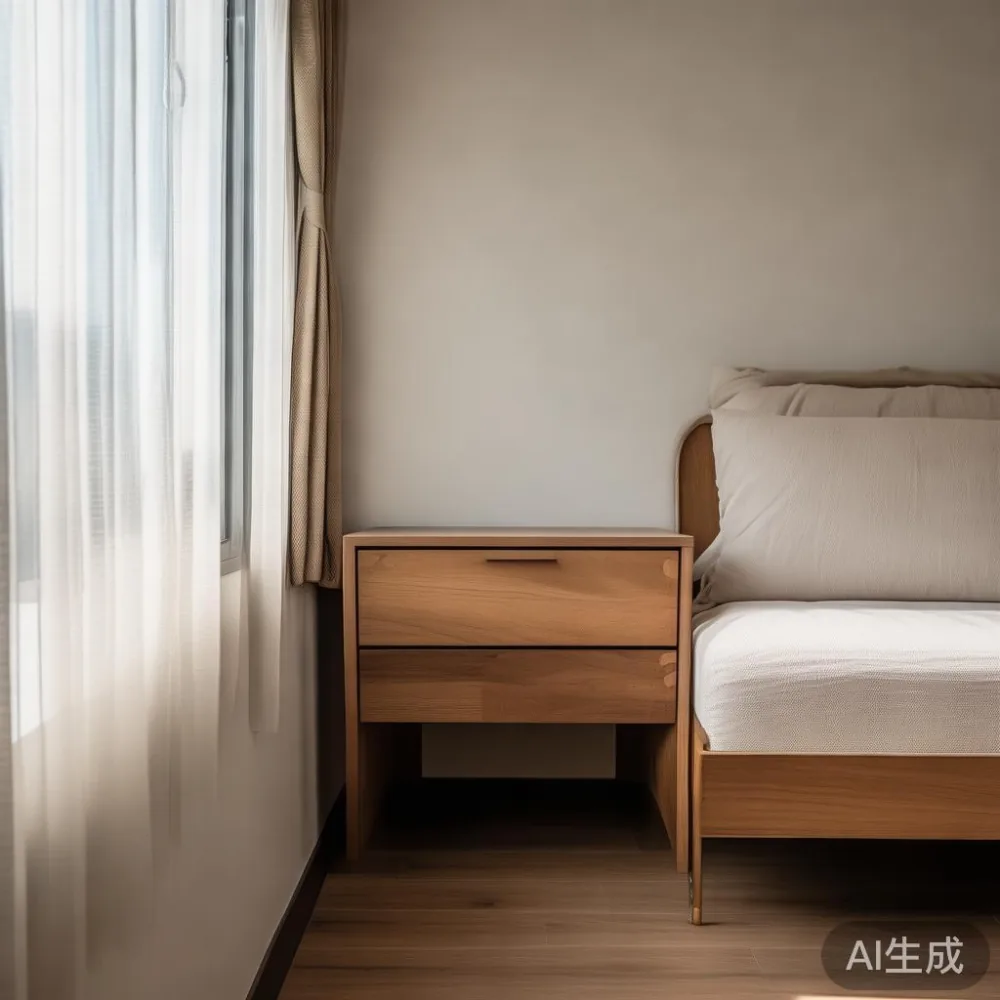
What they were missing was not more furniture. It was warmth, proportion, and a sense of weight under the hand. That is what a warm minimal interior actually asks of you, and that is what this guide is built around. Because you cannot fake warmth with cushions alone; you have to choose pieces with material honesty, and the bedside table is the easiest place to start.
Throughout this piece I will use examples drawn from Singapore homes, HDB corridor and lift constraints, and the realities of ordering solid wood pieces from a Foshan workshop such as MIDHILL, which has been exporting solid wood furniture since 2008, ships free above US$350, and offers a 10-year structural warranty plus lifetime refinishing. I will keep prices in SGD, include 9% GST where relevant, and stay inside one category: matching a warm minimal interior with the right bedside table, bed frame, wardrobe, and dining table.
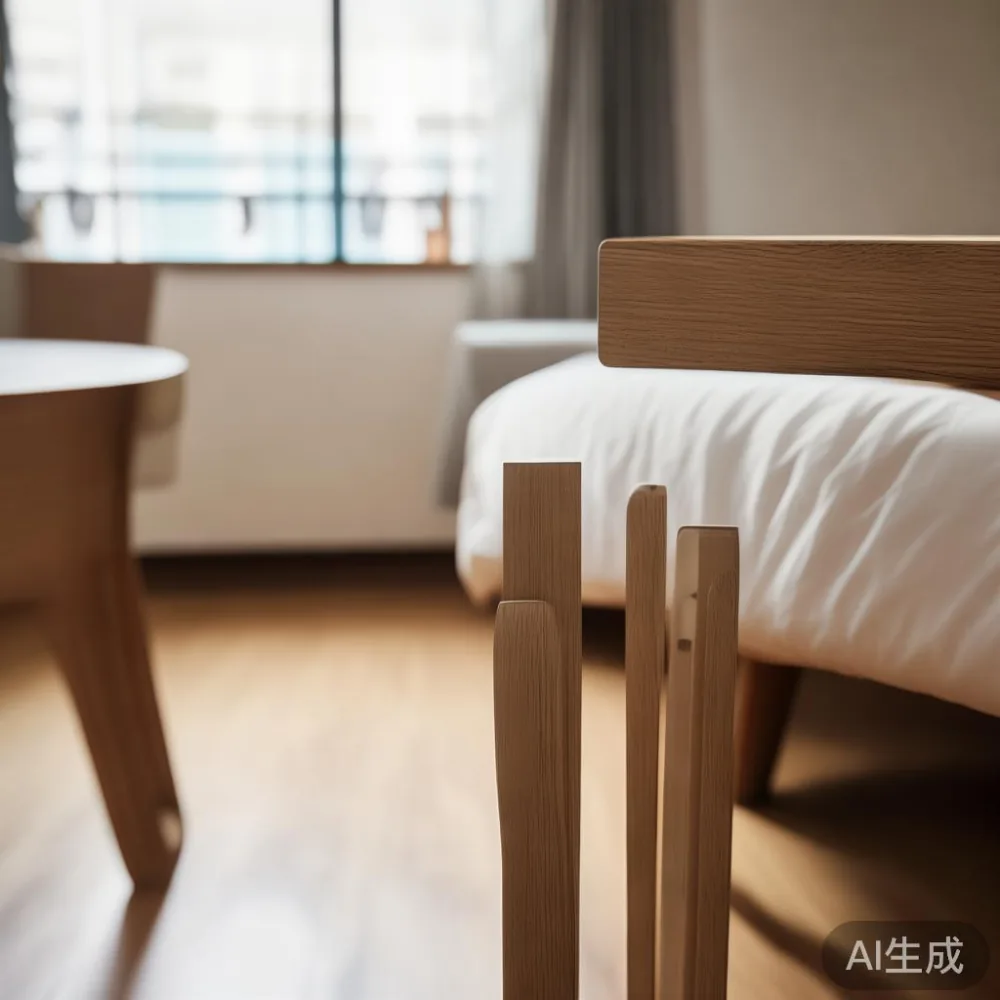
What does "warm minimal" actually mean in a 92 sqm HDB?
Warm minimal is a calibrated interior, not a sparse one. You keep the lines clean and the surface count low, but you let one or two natural materials carry the room. In Singapore HDBs and newer condos in Punggol, Sengkang and the OCR, that usually means pale walls (Dulux Whisper White or Jotun Lady 9917 Silk Finish, both around S$18 to S$24 per litre), a light-oak or ash-tone surface, and one darker accent in solid wood.
The mistake I see most often is people going too Scandinavian, too cool, too pale. Pure white walls, 4000K light, a chrome tap, and a bleached oak surface read as a clinic. You want 2700K bulbs (a pack of four from Philips costs about S$22 in Singapore), a wall tone with a yellow undertone, and a bedside table in a wood that has visible grain. A bedside table is the smallest piece in the bedroom, but it is also the one your hand touches every night, so it sets the temperature of the whole room.
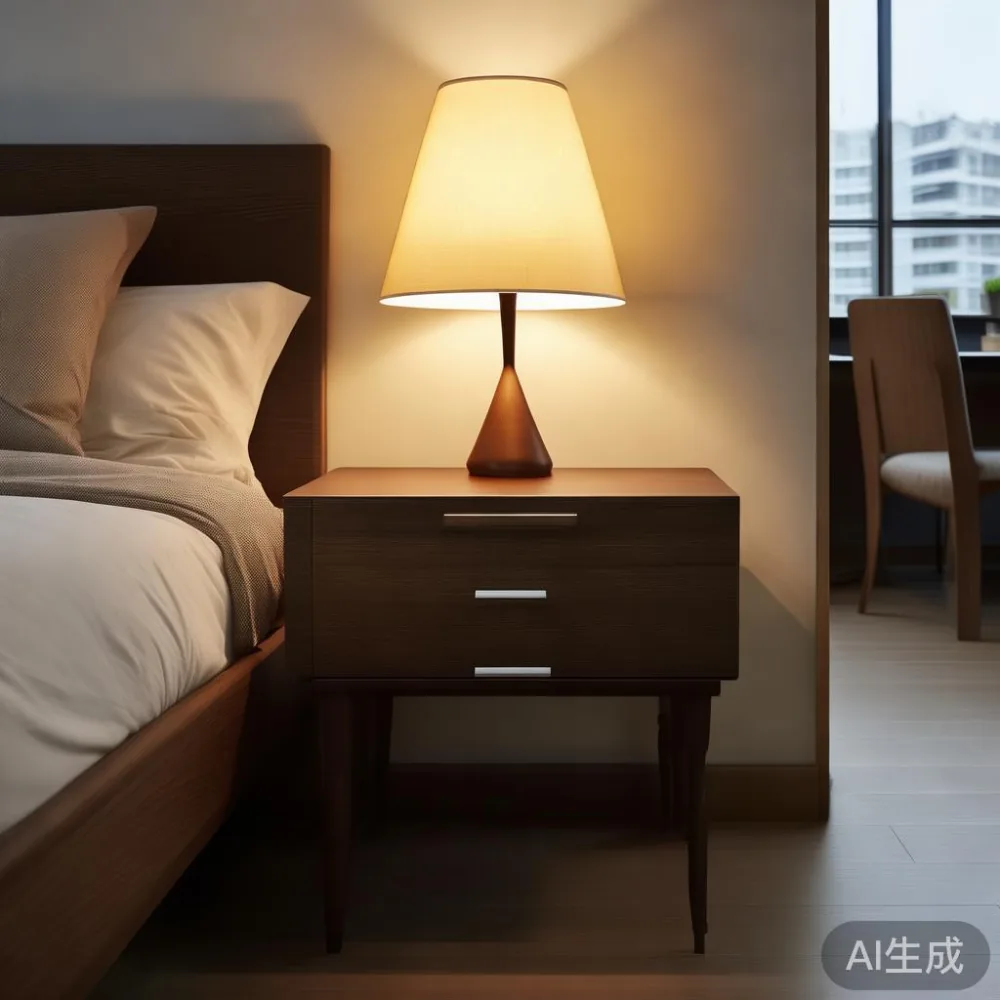
How do you pick a bedside table that warms up a minimal bedroom?
Start with three numbers: width, height, and material weight. For a Singaporean king-size bed at 183 cm by 191 cm, you want a bedside table roughly 45 to 55 cm wide, 50 to 60 cm tall, and at least 35 cm deep so a 13-inch laptop can sit on it. Anything narrower than 40 cm looks like an afterthought next to a 183 cm mattress.
Material is where the warmth lives. A white laminate bedside table is the safe choice (around S$189 to S$289 at Taobao, HipVan, or Castlery), but it will not bring warmth. A solid wood bedside table in walnut, white oak, or ash at 45 by 45 by 55 cm typically lands between S$549 and S$1,180 in Singapore, depending on whether the drawers are dovetailed and whether the top is a single board. The heavier the piece (a solid oak unit usually weighs 65 to 75 kg shipped), the more it grounds the bed.
I tested two units side by side in a Bedok Reservoir HDB last spring: a S$259 MDF unit in walnut veneer, and a S$749 solid ash unit with two soft-close drawers. The MDF unit moved slightly when I pulled the drawer hard. The ash unit did not. The ash unit also took a candle burn without leaving a mark after a light sanding. That is the kind of thing you cannot fake with veneer. If you want to compare options and pricing for solid wood nightstands and bedside tables, the catalogue at midhill.co lists each wood with thickness, drawer joinery, and a small video of the soft-close action, which is rare for this category.
Three rules for a warm-minimal bedside table:
- Pick a wood with visible grain: ash, white oak, walnut, or warm-tone teak. Avoid maple if your walls are already cool.
- Keep the silhouette simple: a rectangular box, a round top on a slim frame, or a single-drawer plus open shelf.
- Match the wood tone of your bed frame within two shades, not exactly. Exact match reads as a flat interior.
French bed vs Mid-century modern bed: which one warms a minimal room?
This is the most common comparison I get asked, and the answer depends on your wall colour and your floor. A French bed leans into turned legs, a slightly curved headboard in linen, and brass or antique-finish hardware. A Mid-century modern bed has cleaner geometry, a lower profile (headboard usually 90 to 110 cm tall), and tapered legs in walnut or teak.
In a Singapore HDB with 2.7 m ceilings, a French bed can feel heavy if the headboard is over 120 cm. I would cap a French-style bed headboard at 105 cm in a standard room. A Mid-century modern bed reads lighter, which is why it is often the safer choice for compact rooms in Tampines and Punggol.
If you want to compare a French bed vs Mid-century modern bed for your own bedroom, do this test: place a 1.5 m wide piece of cardboard against the wall at 100 cm tall and live with it for two days. If it feels too tall, go Mid-century. If it feels too short, go French. That 15 to 20 cm makes a real difference in a compact room.
French bed vs Italian light luxury bed: how do they actually differ?
People confuse the two because both sit in the light-luxury zone, which is the segment that includes French light luxury, American post-modern light luxury, and Italian light luxury. French light luxury tends to mean a curved headboard, fluted details, warm brass accents, and a softer silhouette. Italian light luxury usually means a platform bed, often upholstered in a thicker weave, with a low profile (seat height 35 to 40 cm), a metal or wood base in dark bronze, and very straight geometry.
In a Tampines HDB with a 183 cm king-size mattress, an Italian platform bed at 215 cm by 215 cm sits well in a 3.2 m by 3.6 m room. A French-style bed with a 105 cm headboard needs at least 2.9 m of wall to breathe. If you are choosing between a French bed vs Italian light luxury bed, your room width and ceiling height will decide for you more than your taste will.
For 2026, I expect the best light luxury bed for 2026 to combine an upholstered headboard in a bouclé or linen-blend fabric (a 2 m wide one is around S$480 to S$720 to reupholster in Singapore) with a solid ash or walnut base, with brass feet or no feet at all. That is a hybrid of French and Italian light luxury, and it photographs well in compact Singapore rooms because the headboard gives warmth and the low base keeps the ceiling visible.
Can you find under 2000 Japandi furniture in Singapore, and what should the package include?
Yes, and this is where most people overspend. A whole-bedroom Japandi package for under S$2000 is realistic if you buy a bed frame, two bedside tables, and a small wardrobe from the same maker, in the same wood, with the same finish. The risk is mixing a S$289 Taobao bedside table with a S$1,800 bed frame; the bedside table will look cheap next to it within six months.
For a 4-room HDB master bedroom, a realistic under-S$2,000 Japandi package looks like this: a queen-size solid ash bed frame at S$1,180, two solid ash bedside tables at S$549 each (so S$1,098 for the pair), and free delivery above US$350 keeps the freight line in check. Total comes to S$2,278 before GST, which is the realistic ceiling. If you can drop to a white oak bed frame at S$1,080, the total lands at S$2,178, still tight. The way to drop under S$2,000 cleanly is to choose one bedside table rather than a pair, or to skip the headboard upholstery.
If you are searching specifically for under 2000 Japandi furniture in Singapore, the smarter move is to bundle a bed frame, two bedside tables, and a 6-seater dining table from one maker. MIDHILL bundles often land in the S$3,800 to S$4,800 range for that exact combination in ash, which is about 18% cheaper per piece than buying each item alone, and the finishes match because they come off the same line.
Where to buy bed from MIDHILL and how does the ordering actually work?
Ordering from a Foshan workshop is not the same as ordering from a Singapore showroom, so the steps matter. If you are asking where to buy bed from MIDHILL, the practical answer is that you spec the bed online, confirm the wood, the size, the headboard height, and the finish by sample, then arrange sea freight or air freight to Singapore. Sea freight from Foshan to Singapore takes 14 to 22 days and costs around S$180 to S$260 for a king-size unit, which is far cheaper than air freight (around S$620 to S$880 for the same item, 5 to 7 days).
I ordered a queen-size ash bed frame from a Foshan workshop for a client in Punggol last year. The bed arrived 18 days after the deposit, and the lift in the HDB block measured 1.1 m wide by 2.0 m deep, which is tight for a king-size headboard. We had to specify a split headboard at 95 cm + 95 cm to get it into the lift. That detail is something you cannot guess from the product photos; you have to ask the maker before paying the deposit. MIDHILL publishes a Singapore shipping guide that calls out lift and corridor widths (typically 0.9 m to 1.2 m for HDB lifts, and 1.2 m to 1.5 m for condos in District 15 and 16), and they will split a headboard at no extra charge if you ask in advance.
What about the dining table, marble table, wardrobe, and sofa in a warm minimal flat?
The same logic applies. A warm minimal flat uses one warm material in each room, not five. In the living room, a solid wood sofa frame in ash or walnut (a 2.4 m three-seater at around S$2,180 to S$3,480) paired with linen-look cushions in a clay or oatmeal tone reads warmer than a chrome-and-glass setup. In the dining room, a 1.6 m solid wood dining table in ash (about S$1,480 to S$2,280 for a six-seater) reads warmer than a white marble table. If you want the marble look without the cool temperature, pick a marble table with warm veining, such as a Crema Marfil or a Boticcino finish, and pair it with a darker wood base so the room does not feel like a gallery.
For the wardrobe, a floor-to-ceiling solid wood wardrobe in white oak at 240 cm by 60 cm by 220 cm lands between S$2,880 and S$3,980 in Singapore for a 3-door unit, which is more than a laminate wardrobe (around S$1,180 to S$1,880) but lasts roughly three times longer under Singapore humidity (average 78% to 92% RH year-round). The wardrobe is the single biggest surface in the bedroom, so its material sets the warmth level for the room more than the bed does. If the wardrobe is cool, the bedside table cannot save the room. If the wardrobe is warm, even a basic MDF bedside table will look acceptable for the first two years.
How do you keep a warm minimal interior warm in Singapore humidity?
Three practical habits. First, run a 12-hour dehumidifier cycle in the bedroom at 50% to 55% RH; a typical Meaco or Mitsubishi unit costs about S$0.12 per S$ in electricity per day at Singapore's tariff of about S$0.32 per kWh, so the monthly cost is around S$3.60. Second, keep solid wood pieces 8 to 10 cm off the wall so air circulates behind them. Third, refinish the bedside table top once every 18 months; the lifetime refinishing service that comes with pieces from MIDHILL costs S$0 if you ship the top back to Foshan, or about S$120 to S$180 to refinish locally in Singapore through a third-party workshop.
For the marble table, seal it once a year with a penetrating sealer (about S$48 for a 1-litre tin of Dry-Treat STPP at Hafary or Soon Bee Huat). For the wardrobe, wipe the inside with a dry microfibre cloth every fortnight to keep the cedar or oak lining dry. None of this takes more than 20 minutes per month, and it keeps the room reading warm rather than tired.
What does a warm minimal bedroom actually look like once it is finished?
It looks like a room with fewer objects and heavier materials. The bed frame is solid ash or walnut, the headboard is upholstered in a clay-tone linen, the two bedside tables are matching solid ash with single drawers, the wardrobe is a floor-to-ceiling oak unit with recessed pulls, and the floor is a light-oak engineered timber (around S$9 to S$14 per sqf installed). The only metal in the room is the lamp hardware, and the only glass is the window. That is the warm minimal interior in practice: not five new amenities, just the right three pieces in the right wood.
For the best light luxury furniture Australia or Singapore buyers ask about, the answer is rarely the most expensive piece. It is the piece with the right weight, the right wood, and the right finish, placed in a room where the wall colour is warm and the lighting is 2700K. If you want to start with one piece, start with the bedside table. You touch it every night. If it feels heavy, warm, and quiet under your hand, the rest of the room will follow.
For the broader package, browse the full MIDHILL catalogue at midhill.co, where bed frames, bedside tables, wardrobes, dining tables, marble tables, and solid wood sofas are listed with thickness, weight, and lead time, so you can spec a whole Singapore home in warm wood without leaving the lift lobby.