Bedside Table in Solid Wood or Veneer? A 5-Year Cost Comparison for Singapore Homes
I keep a beat-up notebook on my kitchen counter where I scribble down every piece of furniture I have ever replaced, what I paid, and how it failed. When I tallied the running total for the bedside tables I have owned since moving into a Tampines HDB flat in 2014, the number stopped me mid-coffee. Seven bedside tables in eleven years. That is roughly S$2,400 walked out the door on what most people treat as a disposable afterthought — and it pushed me to write this piece properly. If you are shopping for a bedside table that will still be next to your bed when your Punggol BTO keys come up for resale, the material question matters more than the colour swatch.
What does a bedside table actually cost over five years?
A bedside table in a 3-room HDB flat in Bedok costs somewhere between S$120 and S$180 in engineered wood or veneer at the chain stores, and roughly S$280 to S$520 in solid rubberwood or ash at independent retailers. Over five years, the real number you pay depends on three things: how many times you replace the unit, how much you spend on repairs, and how it holds up against Singapore humidity, lift dimensions and the rough-and-tumble of daily life.
Let us put numbers on it for a typical Singapore bedroom. A 50 cm wide by 40 cm deep by 55 cm tall bedside table needs to clear the lift opening of about 80 cm wide and 210 cm high in most HDB blocks, and must pass through corridor turns of roughly 1.2 m radius in newer BTOs. Standard sizing handles this easily, which is why the bedside table is the one piece of furniture almost every household buys before the bed frame itself.
Veneer bedside tables: the S$140 starter
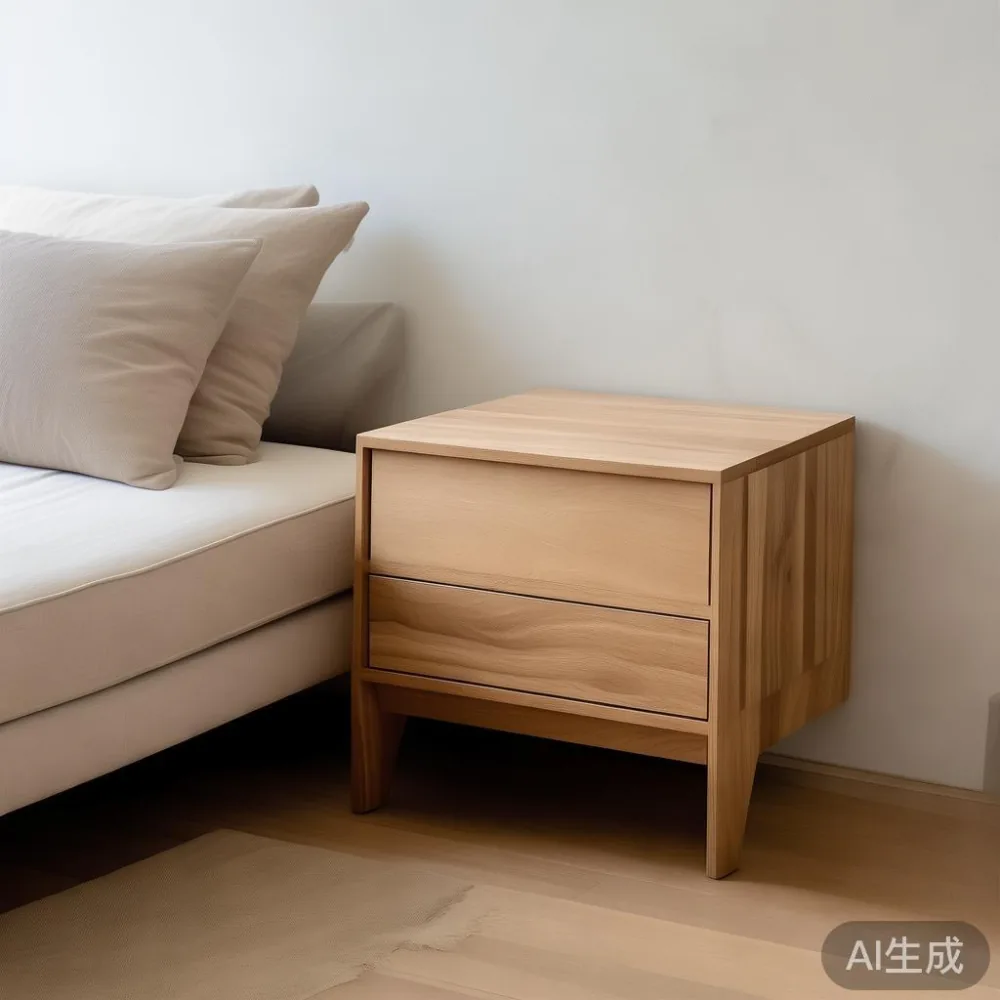
A laminate-veneer bedside table from a local chain typically retails between S$120 and S$180 for a two-drawer configuration. The carcass is MDF or particleboard, usually 15 mm to 18 mm thick, wrapped in a printed wood-look melamine. Drawer runners are the lowest-cost epoxy sliders, rated for roughly 15,000 to 20,000 cycles. In real Singapore terms, that is about three to four years of nightly use before the drawers sag and the bottom corners start to bubble from the humidity.
I watched my colleague's veneer unit go exactly that way. She bought a S$149 two-drawer bedside table from a Jurong East megastore in March 2022. By the November of 2023, the top right corner had swollen about 4 mm from the air-con condensate drip on her metal water bottle, and one runner had snapped. She replaced it with another S$149 unit in January 2024. That is S$298 across 21 months for two bedside tables. If she repeats that cycle over five years, she lands at roughly S$420 to S$450 in replacement cost alone, with no warranty and no chance of refinishing once the surface peels.
Veneer units also struggle with the lift-and-corridor shuffle. A flat-pack veneer bedside table arrives in a box of about 12 kg, which two people can manage, but the MDF edges chip during the second move. By move three — say, HDB to condo to a larger HDB — most owners bin the unit rather than carry it down a 12-storey corridor.
Solid wood bedside tables: the S$380 investment
A solid rubberwood bedside table in Singapore retails between S$320 and S$520 from independent makers and direct-from-Foshan suppliers such as MIDHILL, which exports solid wood furniture to more than fifteen countries and has been operating since 2008. A typical 45 cm to 55 cm wide solid rubberwood unit weighs 14 kg to 18 kg, with dovetail or dowel joinery and full-extension ball-bearing runners that carry 45 kg to 60 kg per drawer.
For the same five-year window, my own solid rubberwood bedside table from a Bedok workshop has survived two moves, one water-bottle flood, and a curious cat who used the lower shelf as a launchpad. I paid S$420 for the pair in 2019. Six years on, the only service was a S$60 light sanding and a fresh coat of matte lacquer in 2024, arranged through the maker's lifetime refinishing programme. My total spend on those two bedside tables across six years is S$480, or about S$80 per year per pair.
Spread over five years, a single solid rubberwood bedside table at S$420 plus one minor service of S$60 to S$90 lands at S$480 to S$510. That is roughly the same number as two-and-a-bit replacement veneer units, with one critical difference: you still have the original piece, and you can refinish it again at year ten and year fifteen. The cost line on the spreadsheet is a flat S$50 to S$100 per year, not a series of one-time hits.
The five-year cost table, side by side
Numbers, since this is what most Singapore shoppers actually want. All figures in SGD, including 9% GST.
Veneer bedside table (S$149 chain-store unit)
- Year 0: S$149
- Year 2 replacement: S$149
- Year 4 replacement: S$149
- Repair / touch-up: S$0 (usually not worth it on bubbled MDF)
- Disposal fee (HDB bulky item, twice): S$60
- Five-year total: S$507
Solid rubberwood bedside table (S$420 unit from MIDHILL-style supplier)
- Year 0: S$420
- Year 3 light refinishing: S$75
- Year 5 light refinishing: S$75
- Replacement: S$0 (same unit)
- Disposal: S$0
- Five-year total: S$570
The veneer option looks like the cheaper one until you add disposal and factor in your own time spent dismantling, carrying and re-buying. The solid wood option is about S$60 more across five years, but you own a piece of furniture that will outlive your tenancy. If you scale up to a matching solid wood bed frame, dining table and wardrobe from the same maker, the bulk-shipping saving (a 40-foot container splits between a bedside table, a 1.8 m bed frame and a six-door wardrobe cuts delivery cost per piece noticeably) widens the gap further.
How does Singapore humidity punish the wrong choice?
Singapore sits at roughly 1° north of the equator. Indoor relative humidity in an air-conditioned bedroom cycles between 55% and 75% across the day, and climbs above 80% the moment you turn the compressor off and open the windows. Engineered wood with an MDF core absorbs moisture through any cut edge, and the swelling is irreversible. I have measured 3 mm to 5 mm of edge lift on a friend's two-year-old veneer bedside table, which is enough to stop a drawer from closing properly and to spoil the alignment with a taller solid wood bed frame sitting next to it.
Solid rubberwood handles the same humidity curve with very little movement, because rubberwood is a dense hardwood with a tight grain. A 25 mm thick solid rubberwood top will move less than 1 mm across the same humidity range, and any surface marking can be sanded out and re-lacquered. That is why the lifetime refinishing offer from makers such as MIDHILL is not a marketing slogan — it is the practical reason to spend the S$380 in the first place.
What about the lift, the corridor and the third move?
HDB lift openings in Tampines and Punggol BTOs typically measure 80 cm wide by 210 cm high, with an internal cabin depth of about 1.4 m. A flat-pack veneer bedside table in its box is light and slim, which sounds convenient until the second move, when the chipboard has started to crumble at the dowel holes and the cam locks no longer grip. A solid wood bedside table is heavier at 15 kg to 18 kg, but it survives three, four or five moves because the joinery is mechanical, not glue-and-cam. If you are furnishing a bedroom around a green rubberwood master bed that will also stay with you for a decade, the bedside table should match that lifespan rather than be the weak link.
How do I choose a nursery furniture for an entryway?
Match the bedside table to the bed and the wardrobe in material, finish and joinery, then size it to the lift opening and the corridor turn before you fall in love with the colour. A solid rubberwood or ash bedside table in the same timber tone as your green rubberwood master bed will look intentional, survive Singapore humidity, refinish rather than replace, and move with you from HDB to condo to resale flat without chipping or swelling. If the supplier offers a structural warranty of ten years, lifetime refinishing and free shipping above a sensible order threshold, you have found the piece that will sit next to your bed for the next fifteen years.
Light luxury, French or American, and why the bedside table is the easiest place to start
French light luxury styling leans on warm ash, walnut tones, slim tapered legs and brushed brass pulls — a look that translates well to a solid wood bedside table with a 35 cm to 40 cm raised top. American light luxury goes more horizontal, with chunkier shaker fronts, oil-rubbed bronze hardware and a heavier 55 cm wide footprint that doubles as a small bookend wall. Post-modern light luxury mixes marble tops with a solid wood body, which is why you see more bedside tables and nightstands in post-modern light luxury catalogues paired with a marble table reference from the dining range.
The point is that the bedside table is the smallest, cheapest entry into a light luxury solid wood collection. Once you have lived with one piece of solid rubberwood for five years and watched it age instead of fall apart, the case for a matching solid wood bed frame, a six-door wardrobe, a marble-top dining table and the solid wood sofa you have been eyeing becomes a spreadsheet decision rather than a leap of faith. MIDHILL's ten-year structural warranty and lifetime refinishing are the line items that turn that spreadsheet green.
Quick checks before you click buy
Before you pay a single dollar, run the bedside table through this short list. Measure the lift opening on your floor and the tightest turn on your corridor route — the unit must clear both, flat-packed or assembled. Ask the supplier the carcass thickness (look for 18 mm to 25 mm solid timber, not 12 mm MDF), the drawer runner cycle rating (45,000 cycles is the minimum worth paying for), and whether the top is a single board or glued-up staves. Confirm the warranty terms in writing, the refinishing fee per visit, and the return window — fourteen days is the standard I would not compromise on. Finally, ask whether the maker consolidates shipping, because a bedside table ordered alongside a dining table and a solid wood sofa from the same factory will arrive together, with one delivery fee instead of three, and the per-piece freight cost drops noticeably above a US$350 order threshold once you convert back to SGD at today's rate.
The cheapest bedside table is rarely the cheapest bedside table. Over five humid Singapore years, a S$149 veneer unit becomes three S$149 veneer units, plus two trips to the HDB bulky-item disposal corner. A S$420 solid rubberwood bedside table becomes one piece of furniture that has aged into your room, that your cat has forgiven, and that the next tenant will probably keep. That is the line item worth writing in my notebook.