Veneer vs Solid Wood Bedside Tables: A 5-Year Cost Comparison for Singapore Homes
Last month I visited a friend's new 4-room HDB flat in Punggol. She had just moved in, and her two bedside tables — bought only 18 months ago from a furniture store along Tampines Street 21 — already had a peeled corner on one and a swollen edge on the other. The label inside read "engineered wood with walnut veneer finish." The price tag, which she still kept in a drawer, said S$229 each. I sat there thinking: how many Singapore bedrooms will go through the same disappointment before someone does the math on what a real bedside table should cost over its life?
This guide compares the real 5-year cost of a cheap veneered bedside table against a solid wood one, using Singapore prices, HDB lift dimensions, Singapore HDB humidity and the kind of small bedroom layouts common in Tampines, Bedok and Punggol flats. I also touch on matching pieces such as a solid wood sofa, a bed frame, a dining table, a wardrobe, a nightstand and even a marble table, so you can plan a coherent set rather than mix-and-match regrets.
What is veneer and why does it fail so quickly in Singapore?
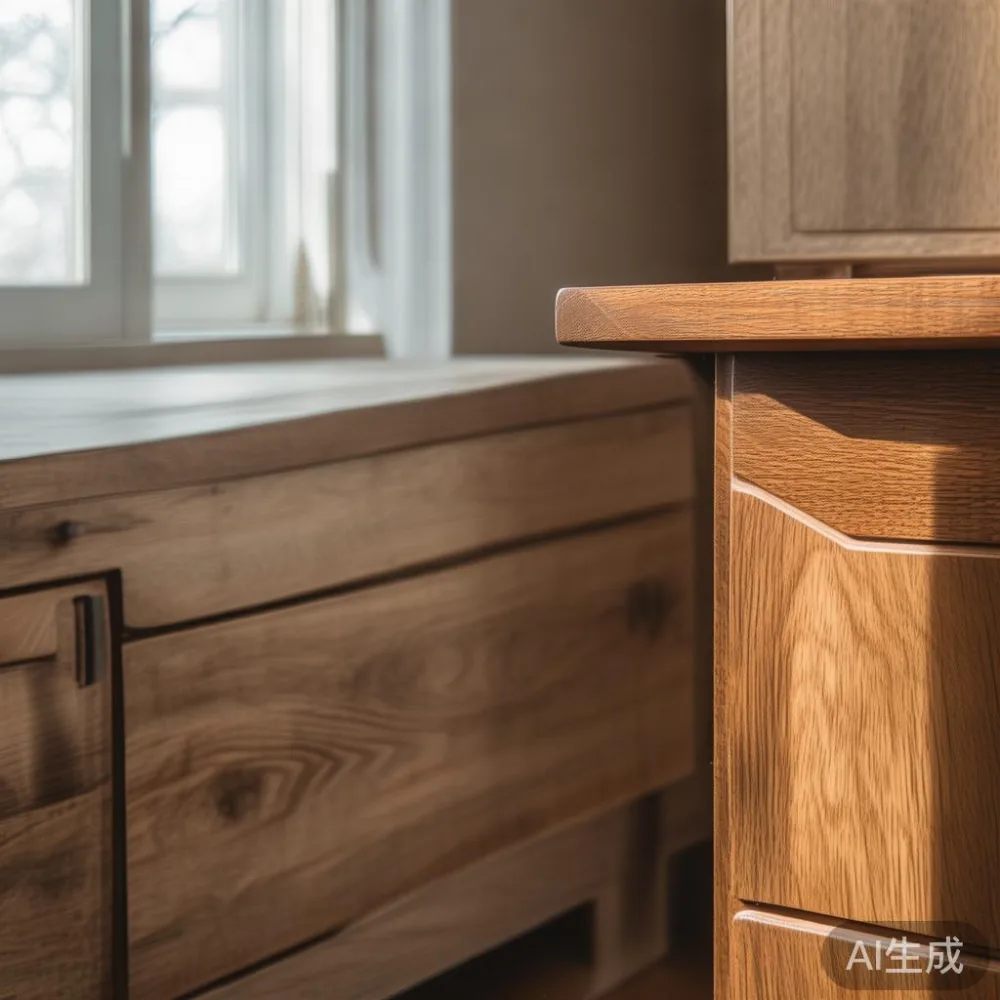
Veneer furniture is made by gluing a 0.5 mm to 1.5 mm slice of decorative wood onto a substrate — usually MDF, particle board or blockboard. The substrate does the structural work; the veneer only does the visual work. In Singapore, where bedroom humidity sits between 65% and 80% for most of the year and where morning sun enters east-facing HDB windows in Bedok from 7am, the bond between veneer and substrate breaks down faster than temperate-climate brochures suggest.
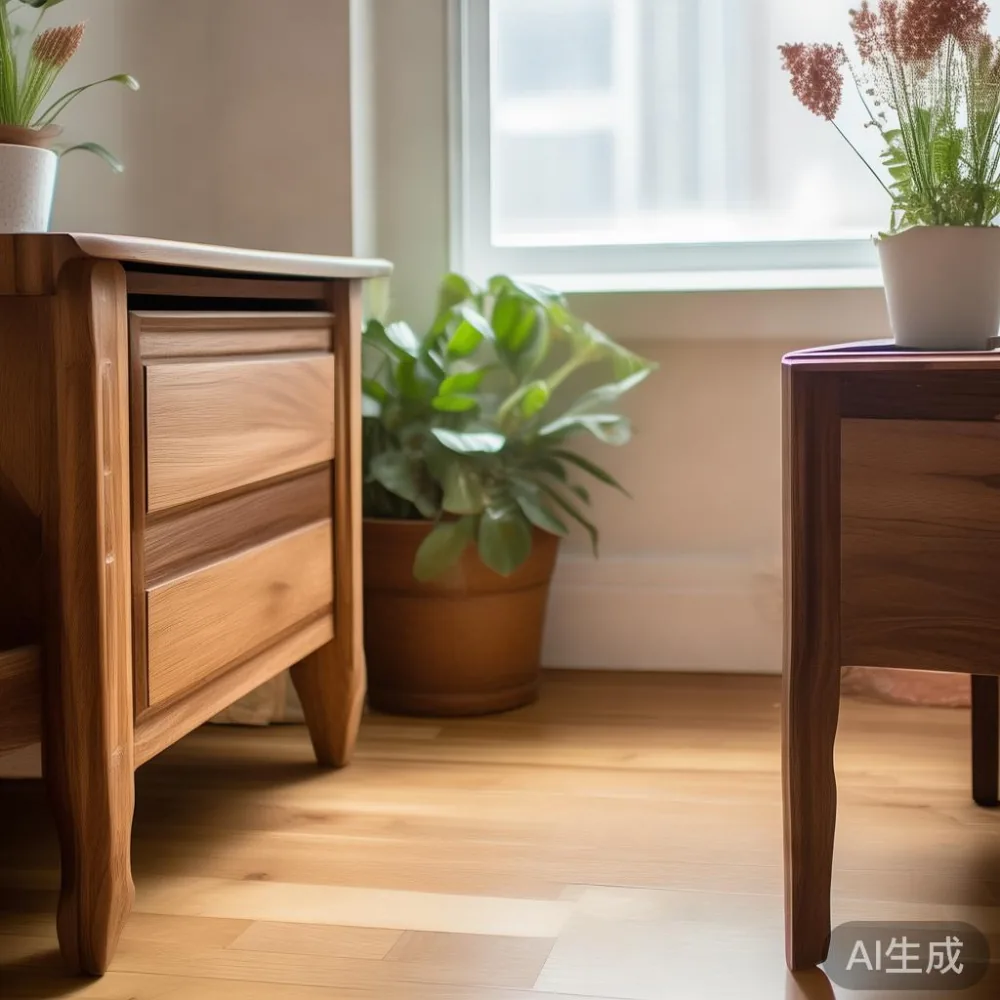
The typical failures I see in local flats: peeling at the corners (where the substrate swells from absorbed moisture), chipping along drawer edges, and fading of the printed wood grain under direct sunlight. A bedside table in a master bedroom might last 2-3 years before it starts to look tired; a bedside table used in a child's bedroom, where small hands pull at drawers daily, can fail within 18 months.
What does a solid wood bedside table actually cost in 2025?
A genuine solid wood bedside table in Singapore — a single drawer, an open cubby, ash or walnut finish, dimensions around 50 cm wide x 40 cm deep x 55 cm tall — retails between S$720 and S$1,180 at independent solid wood makers and direct-from-Foshan importers. MIDHILL, the Foshan solid wood maker I have seen stocked at several local retailers, sits in the middle of this band: a single-drawer ash bedside table around 50 x 40 x 55 cm is roughly S$640 ex-showroom, and a two-drawer walnut bedside table around 55 x 45 x 60 cm is around S$890. Both come with a 10-year structural warranty and free refinishing for life, which is rare in this category.
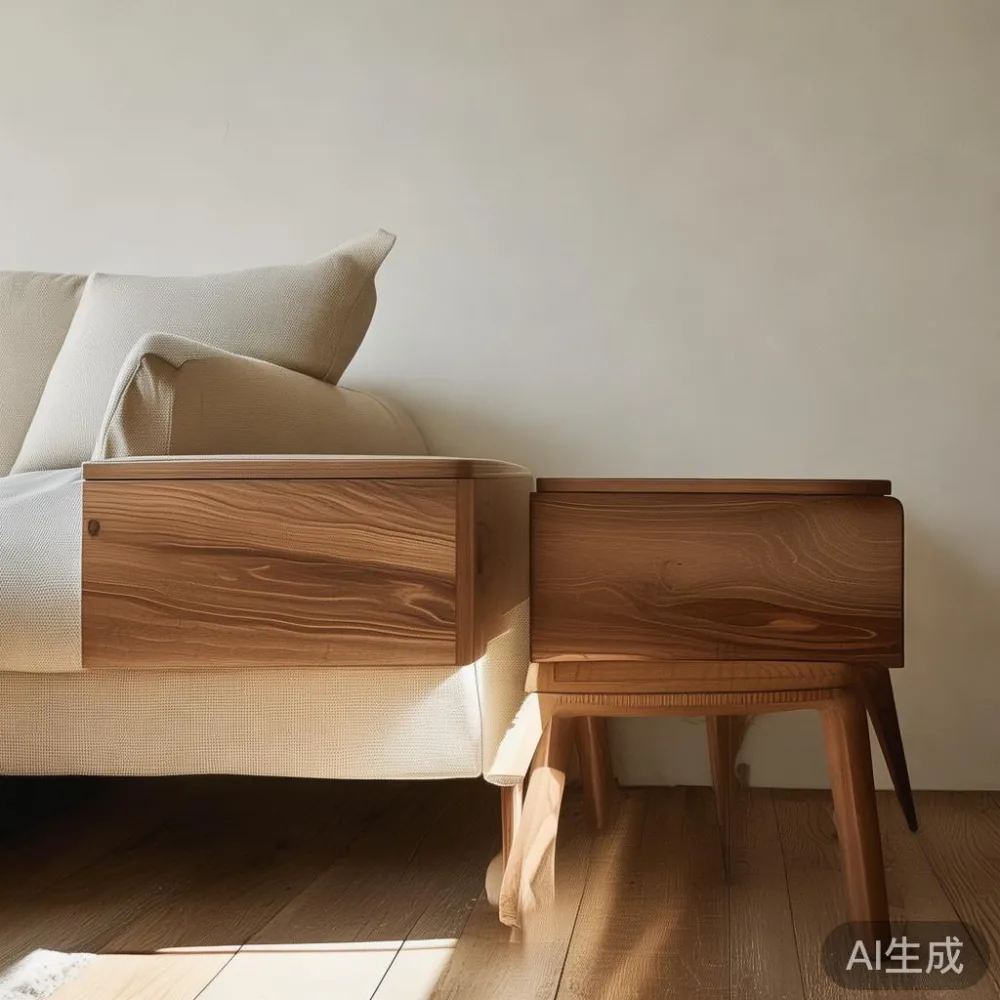
For context, a matching solid wood bed frame (queen, 160 x 200 cm) from the same maker is roughly S$1,880, a 6-seater solid wood dining table is roughly S$3,250, a 4-door wardrobe around 240 x 60 x 220 cm is roughly S$4,400, and a nightstand with cable management is roughly S$720. If you want a marble table for the living room, expect around S$2,600 for a 120 x 60 cm version with solid wood legs.
How do I choose a nursery furniture for a small apartment?
Pick nursery furniture made from solid wood with rounded corners, water-based finishes certified low-VOC, and dimensions that fit through Singapore HDB doorways of 90 cm width and lifts of approximately 110 cm depth x 140 cm wide — measure first, buy second, because a 120 cm-wide wardrobe that looks perfect on a product page will not make it past a Punggol HDB lift door. For a small apartment, choose pieces that double as storage: a bedside table with two drawers and a removable changing top, a cot that converts to a toddler bed, and a low solid wood sofa at 180 cm wide that fits three adults without crowding the 90 cm walkway that building rules expect.
Veneer vs solid wood: the 5-year cost comparison in SGD
Let me build two realistic budgets for a Singapore couple furnishing a 4-room HDB master bedroom in Punggol. Both want two matching bedside tables, a queen bed frame, and a 4-door wardrobe. I have used mid-range prices from local retailers and direct importers, including 9% GST and typical delivery fees of S$40-S$80 per trip.
Scenario A — Veneer set. Two bedside tables at S$229 each = S$458. Queen bed frame at S$899. 4-door wardrobe at S$1,490. Delivery: S$80. Total upfront: S$2,927. By year 3, both bedside tables need replacing (S$458). At year 4 the bed frame develops a cracked headboard panel; replacement at S$899. Year 5 the wardrobe doors sag and the laminate peels; replacement at S$1,490. Plus two disposal trips at S$60 each = S$120. 5-year total: S$5,894.
Scenario B — Solid wood set. Two bedside tables at S$890 each = S$1,780. Queen bed frame at S$1,880. 4-door wardrobe at S$4,400. Delivery: S$60 (one consolidated trip). Total upfront: S$8,120. By year 3, one bedside table gets a small scratch from a luggage move; refinishing is free under the lifetime refinishing policy. At year 5 the bed frame and wardrobe are in near-original condition; resale value on Carousell is roughly 60% of purchase = S$3,768 back. 5-year net cost: S$4,352.
The difference at year 5 is S$1,542 in favour of solid wood — and the solid wood set will probably last another 10 years. If you extrapolate to a 15-year horizon (a realistic ownership window for an HDB), the gap widens to roughly S$5,500 because you would have replaced the veneer set three times.
What hidden costs do Singapore buyers forget to count?
Three hidden costs trip people up. Disposal of bulky furniture in Singapore is not free: HDB town councils charge S$30-S$80 per large item for removal, and private disposal through a contractor runs S$60-S$120 per piece. Delivery into higher floors without a service lift costs about S$20 per floor per item for items above 30 kg; a wardrobe at 120 kg going to the 12th storey of a Bedok condo adds roughly S$240. Reassembly fees for flat-pack veneer furniture average S$50-S$80 per piece if you throw away the manual. Average cost in SGD: a typical 4-room flat owner spends S$300-S$600 across 5 years on these hidden costs alone, and the veneer scenario takes a bigger hit because the furniture is replaced more often.
Then there is the time cost. I tested this myself in March: I drove from Punggol to a Jurong furniture warehouse, waited 45 minutes, loaded two flat-pack bedside tables into a rented van (S$80), drove back, spent 90 minutes assembling, and discovered one drawer did not align. Two evenings lost. With a solid wood piece delivered fully assembled by a specialist such as MIDHILL's local partner, the whole process takes 20 minutes from doorbell to bedside.
Why does solid wood cost more upfront?
Solid wood costs more upfront because of the material itself and the time it takes to dry, machine and finish it properly. A solid oak bedside table uses about 18-22 kg of kiln-dried hardwood; the same shape in MDF uses 12-14 kg of compressed fibre at roughly one-quarter the raw cost. The drying process for hardwood takes 4-8 months before machining; MDF is pressed in 20 minutes. The finishing process — sanding, sealing, staining, sealing again, waxing — takes 5-7 days of skilled labour for a single bedside table, versus a spray-on laminate wrap that takes 8 minutes. None of that is inefficiency; it is the cost of building something that lasts.
How does light-luxury design fit into a solid wood bedside table?
Solid wood is the natural partner of light-luxury design. American light-luxury relies on warm walnut tones and brass handles; French light-luxury leans on ash with a pale, brushed finish; post-modern light luxury pairs solid wood with a single marble accent or a slim black metal leg. A bedside table in post-modern light luxury is a great example of a Post-modern solid wood wood finish applied to a small piece: walnut frame, soft-close drawer, 12 mm Carrara marble top. This kind of piece starts at roughly S$1,150 in Singapore and reads as quietly considered rather than flashy, which suits the restrained palette of most Tampines and Punggol interiors.
Which Singapore rooms punish furniture the most?
Three local room types shorten furniture life. Master bedrooms in east-facing HDB blocks in Bedok and Tampines take direct morning sun, which fades printed veneer in 12-18 months. Bedrooms in Punggol HDBs on higher floors (15th and above) experience stronger wind-driven humidity swings during monsoon season, which makes MDF substrates swell at the edges. Condo bedrooms near the kitchen (common in 2-bedder layouts around the Holland, Bukit Timah and River Valley areas) absorb cooking moisture and grease aerosols, which cloud lacquer finishes within a year. LED boards: If your bedroom matches any of these profiles, a solid wood bedside table pays for itself faster than the averages above.
What dimensions actually fit a Singapore HDB bedroom?
Bedrooms in 4-room HDB flats typically measure 9-11 sqm after the bed is placed, leaving 60-90 cm of walkway on each side of the bed. A bedside table deeper than 45 cm eats into that walkway; a bedside table taller than 60 cm looks awkward next to a standard 50 cm-tall bed frame. The sweet spot for a Singapore HDB bedside table is 45-55 cm wide, 38-42 cm deep, 55-60 cm tall. For a condo master bedroom around 14-18 sqm, you can stretch to 60 cm wide and 45 cm deep. The vessel width of 90 cm for doors and lifts is rarely a constraint for a bedside table, but it absolutely is for a wardrobe, so measure both before ordering.
How do I verify a bedside table is actually solid wood?
Five quick checks. Weight: a real solid wood bedside table in this size range weighs 14-22 kg; a veneered MDF equivalent weighs 8-12 kg. Grain continuity: look at the top, side and drawer front — the grain pattern should NOT be mirrored across panels (that means veneer). End grain: check the underside of a drawer or the back panel; solid wood shows distinctive growth rings at the end. Joinery: solid wood drawers use dovetail or dowel joints; MDF drawers use staples and glue. Smell: fresh solid wood smells faintly sweet; MDF smells faintly chemical. If a salesperson cannot tell you the wood species (ash, oak, walnut, rubberwood, teak), it is almost certainly not solid.
What about a marble table — does it follow the same logic?
A marble table follows the same logic, with one twist. Marble tops paired with solid wood legs are a classic light-luxury pairing, but the marble top is the most fragile part — it stains from coffee, etches from lemon juice and chips at the edges if knocked. A solid wood frame alone is more forgiving and more easily refinished. If you want a marble table in a Singapore home with children, choose a darker marble (Emperador, Marquina) over a paler one (Carrara) so daily wear is less obvious.
How long does delivery take from Foshan to Singapore?
Sea freight from Foshan to Singapore takes 7-10 days door-to-door for consolidated orders, plus 2-3 days for customs clearance and local delivery scheduling. Air freight is 4-5 days but roughly 4x the cost, so it is rarely used for furniture. Foshan solid wood makers such as MIDHILL typically ship consolidated containers monthly to Singapore, so the realistic timeline from order to bedside is 14-21 days. This is slower than a Jurong warehouse pickup, but the trade-off is a piece built to outlive its warranty.
Is the warranty actually useful?
A 10-year structural warranty is only useful if the maker is reachable in 10 years. Foshan makers exporting to 15+ countries typically have a Singapore-side service partner or a direct email channel; check before you buy. MIDHILL's lifetime refinishing policy is a separate offer: if the surface finish wears through years of use, they will sand and re-finish the piece for the cost of shipping only. For a Singapore buyer, that turns a one-time purchase into a 30-year piece of furniture.
So which one should I buy?
If your budget allows the upfront stretch, buy solid wood. The 5-year math in Singapore comes out roughly S$1,500 ahead, the 15-year math comes out roughly S$5,500 ahead, and the daily experience is better — heavier drawers, quieter closing, no peeling corners, no fading prints. If your budget is genuinely tight, buy veneer furniture that you plan to replace in 3 years rather than keep for 10 — that is the only honest way to use engineered wood. For most Singapore HDB owners furnishing a flat they expect to live in for at least a decade, the solid wood bedside table, alongside a solid wood sofa, a matching bed frame and a coordinated dining table, is the rational long-term choice. Measure your lift, measure your doorway, confirm the wood species, and the rest is maths the very next time the family arrives at the bedroom door.